pr05 Grant Retrospective
This year, I had the honor of being one of three grantees of Processing Foundation’s pr05 (pronounced “pros”) program.
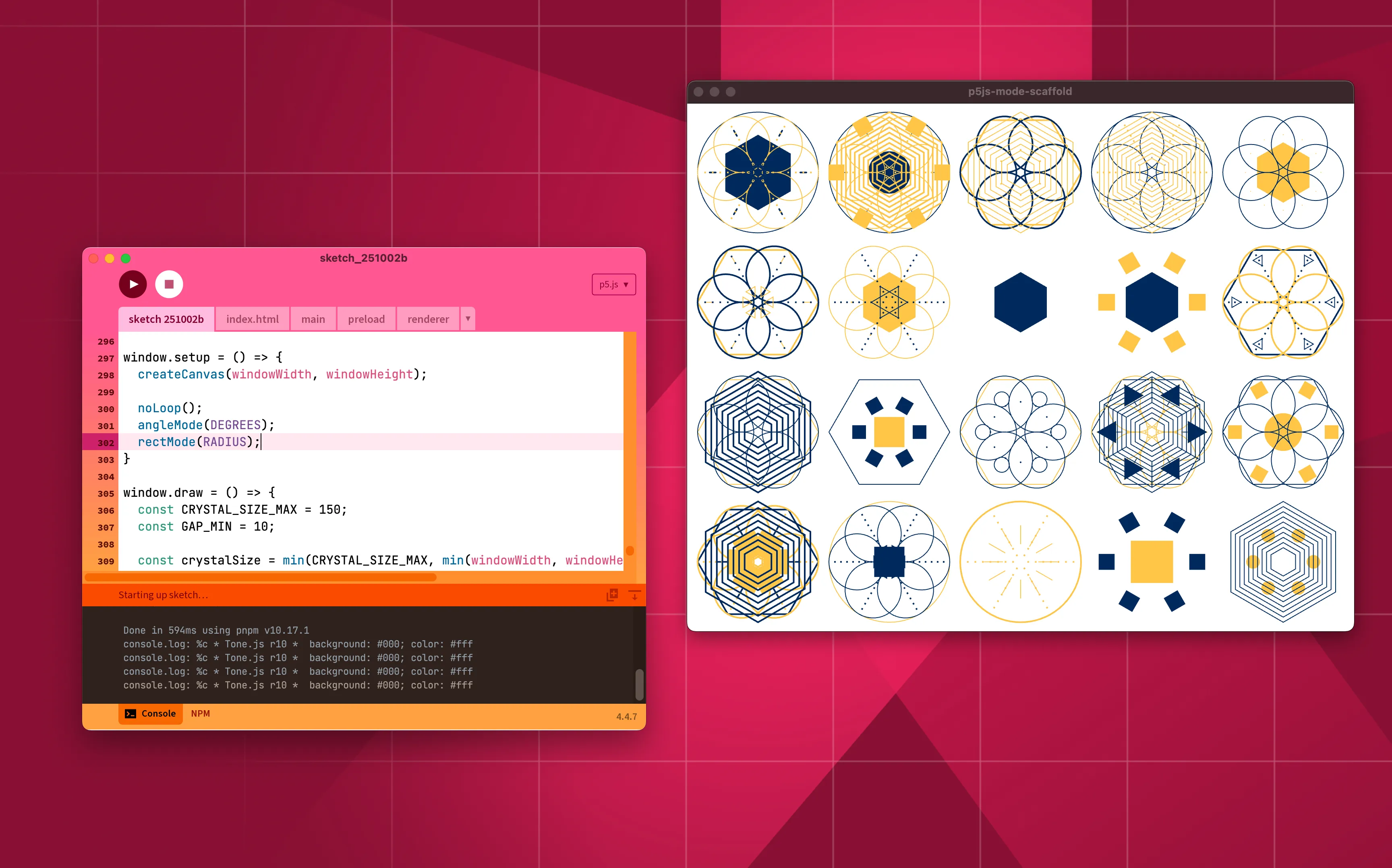
My task was to develop a new Processing mode that allows to create and run p5.js sketches inside the Processing Development Environment (PDE). That included editor support (syntax highlighting, error reporting); cross-platform support for Windows, macOS, and Linux; basic support for installing npm packages inside the PDE; and exporting p5.js sketches as stand-alone desktop applications across the aforementioned platforms. You can find the result of my work in th processing-p5.js-mode repository on GitHub. This will soon move to the official Processing GitHub organization and also be available as an installable contribution via PDE’s Contribution Manager.
This grant gave me the chance to contribute to open source software that I use and cherish; to grow as a person and a developer; and to be part of a community that I have been adoring from the sidelines for years. From July to October—and with a substantial financial backing of $10,000—I found myself surrounded by extraordinary people who supported and joined me in hacking away on one of the most influential tools in the Creative Coding realm.
Now, I know, I know, we humans tend to only see the positive in the rearview mirror and exaggerate or at least grossly misjudge the influence things have on us. This is not the case here; 2025 has been and continues to be a challenging year for me, both personal and professional. Yet, I managed to put in the hours to produce something tangible that will hopefully be helpful to others—all thanks to the four pillars that made this grant program special and meaningful to me.
Pillar 1: The Foundation
My work as a freelance technologist spans creative work and generative art, education and training, and programming in the field of politics and open source intelligence. Some might consider this a wild mix, but if you are looking for like-minded spirits, you don’t have to look far and you will stumble upon the Processing Foundation. Initiated in 2001, the foundation’s goal is to get software and the arts closer together by supporting projects like Processing and p5.js.
I feel, a lot of my core beliefs align well with the work of the foundation:
- Tech should be free/libre and open source
- Facilitating engineers and artists to find insights and joy in each others craft has a high potential to become more than the sum of those parts
- Buzzing creativity and whimsical playfulness can shape tech tools that better your sphere of influence
To quote the Open Assembly event website: shape a more just and equitable future with technology.
That’s the goal! That’s the cause I want to be a part of.
Pillar 2: The Circle
And with this circle I mean the full circle I have come by attending this grant program. Because my deep apprecation for the Processing Foundation does not come out of nowhere: Processing has been my companion for a while!
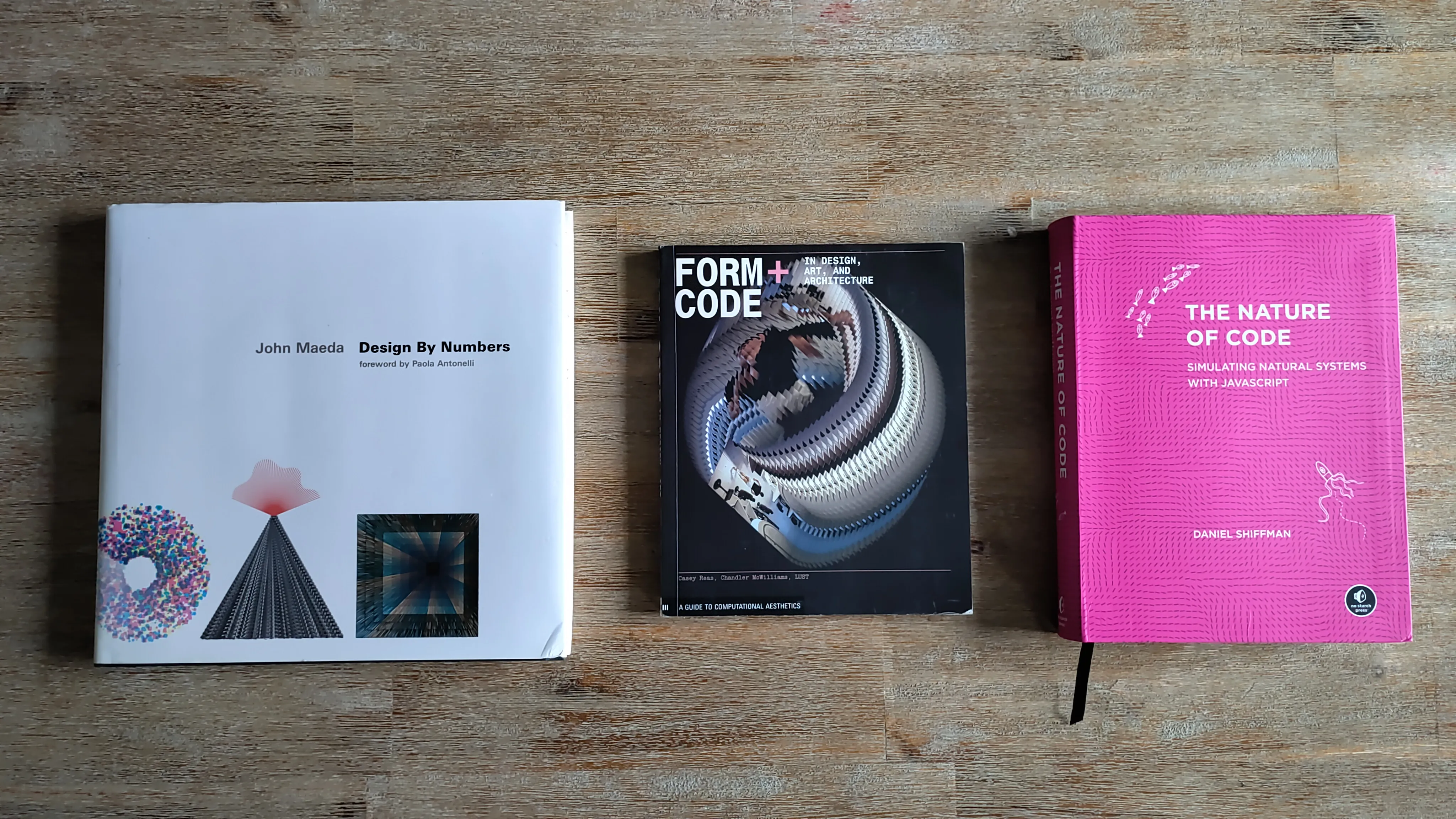
It all started in 2009, when I bought the book Generative Gestaltung: Entwerfen, Programmieren, Visualisieren mit Processing (English title: Generative Design: Visualize, Program, and Create With Processing). 2009! That means I have been working with Processing for over 15 years: At university, lecturing students; on a lazy Sunday, trying out a new creative coding idea; and lately for my pen plotting art.
Pillar 3: The Challenge
Sentimentality aside, I had to learn a couple of things, before I could contribute in a meaningful way. The pr05 grant marked my return to the Java ecosystem and building desktop software, after having built with the web stack for years. I learned my way around the IntelliJ IDEA editor and Processing’s new-ish build system based on Gradle. I learned—and fell in love with—Kotlin and I cannot wait to use my new skills for Android app development. And I used Compose for the user interface which challenged some of my mental models stemming from my work on the web.
To run p5.js sketches—written in JavaScript—in the context of the desktop software Processing—written in Java and Kotlin—we ended up using the Electron framework, that allows both to use the bundled Chromium browser as a rendering engine and to export sketches as stand-alone executables. We also discovered the npm alternative pnpm. This tool excells at installing Node.js dependencies in a storage-efficient manner and doubles as a Node.js version manager, not unlike nvm. That way we are able to ship a Processing mode that assumes no tools being installed on your system, but installs all the necessary tooling when you first start up the mode.
The amount of technologies used and the general level of challenge managed to get me out of my comfort zone and at the same time not be overwhelming.
Personal challenges got in the way, though, and more than once did I face periods of time when I lost my way a bit. I want to thank the people, who massively contributed to me overcoming these periods and not let them get the better of me.
Pillar 4: The Support
Stef Tervelde has been an excellent mentor and acted as an inexhaustible source of advice, workarounds, and guidance. Processing Community Lead Raphaël de Courville supported me with his seemingly endless patience and the right amount of project management. Both Stef and Raphaël kept me from premature rabbit-holing and reminded me that this project ultimately has to be steered by the people who use it. Program Manager Amy B. Woodman helped me remember that it is okay to sprinkle some creative magic on everything—even on a deliverable as rigid as a piece of software.
I know that I still have a lot to learn and that I need to invest in delivering work reliably and steadily—even in the face of personal and global struggles. Thank you!
What’s Next?
You are invited to head on over to the mode’s GitHub repository, have a look at the mode’s README, and give the latest release a spin. I would love for you to get involved, so feel free to drop me an email at work@stephanmax.com or directly create an issue on GitHub should you stumble upon a bug, a feature request, or general questions around the development of this p5.js mode for Processing.
As I hinted at in the beginning, I will fix some breaking bugs and move this project under Processing’s official aegis by December 12.
If that wasn’t clear by now: I wholeheartedly recommend Processing’s grant program and encourage you to check out the Processing Foundation’s website. Make sure to signup for their mailing list while you’re at it, because I am sure they have more goodness cooking.